Sunday, October 26, 2014

Highway Lane Closures - Do You Merge at the Last Opportunity or Do You Merge as Soon as You Can After Seeing the Sign?


Many people would argue that drivers that merge at the last opportunity before the lane closure are committing a “Jerk Merge;” however, writer Tom Vanderbilt would disagree.  Vanderbilt’s book entitled:  Traffic: Why We Drive the Way We Do (and What it Says About Us), argues that if drivers did not leave the soon-to-be-closed-lane until the very point that it actually closed then there would be an orderly and alternating merge that would be as much as 15% faster.  Furthermore, he argues that the queue of vehicles stretching back from the closed-lane-construction-site would be smaller. 

What do you think Michigan Drivers?  Is the last-opportunity-merge a better option for Michigan Road Construction sites and does it offer any safety advantages?

Sunday, September 7, 2014

Do Your New Projector-Type Headlights Fail to Provide Adequate Light On Dark & Undulating Roads?


Do you have a newer model car with headlights that fail to safely illuminate the road?   Do you experience what appears to be a black curtain painted across the upper half of your windshield?  Do you find that you can’t see road signs above a certain height or that when you turn into an unlit driveway you cannot see where you are turning?   Have you noticed that oncoming cars frequently flash their lights at you and you’re momentarily blinded by an intense light glare?

Many newer model cars today are being made with projector headlights. These projector headlights are different than older models’ standard headlights that had separate high beam and low beam light sources.  Projector headlights are lit by a single filament at one focus of an ellipsoidal reflector with a condenser lens in front of the lamp. Between the reflector and the lens there is a shade that provides a cutoff of all light above the center of the light bulb so that, theoretically, the low beams will not blind on-coming drivers with the intense high beam. The shape and sharpness of the cutoff is determined by the shade’s position in the optical system and the shape of the shade’s edge. When the driver turns on the projector’s high beam, the shade is lifted up and removed allowing all the intense light to escape without any cutoff.  The high beam from a projector headlight is a very bright and produces a strong glare that can be blinding to oncoming drivers. 

Many drivers are now noticing that one significant problem with projector headlights on the low beam setting is that the cut-off line of the light moves when the car hits bumps in the road, accelerates, decelerates, and when climbing or going down a slope in the road.  Frequently, drivers now see what appears to be oncoming cars with projector headlights “quickly flashing  their brights;” however, in reality the on-coming car has only hit a bump in the road surface causing the cut-off of light to momentarily shift upward exposing a bright burst of the high intensity light.  This apparent flashing of the high beams can be really annoying; however, a greater safety concern is that the projector headlights’ cut-off of  light moves when the car is going up or down a slope or carrying a heavy load in the back of the vehicle.  While going down a slope the projector’s cut-off of light shifts downward and the headlight’s beam distance is significantly diminished out in front of the car (headlights appear to be driven down into the road surface).  Obviously, this creates a safety issue because the driver cannot see pedestrians and animals out in front of the car to allow adequate and safe stopping distances.  Additionally, road safety signs cannot be read on undulating roads because they are not illuminated since the beam of light is being driven down on the down-slopes.  Likewise, when a driver is driving up a grade the projector’s cut-off  of light shifts up further than it would on a flat road and more of the high beam intense light is unintentionally directed into the eyes of oncoming traffic.  Both of these two unintended consequences of projector headlights can lead to extremely dangerous driving conditions for drivers on Michigan roads and freeways. 


If you are currently driving an automobile with projector headlights, have you experience problems with the headlights?   Please let us know about your experiences and concerns.  

Wednesday, July 2, 2014

Do Crosswalk Countdown Timers Make Intersections More Dangerous?


A recent study by University of Calgary economists Arvind Magesan and Sacha Kapoor investigated the effects of the city of Toronto installing crosswalk-count-down timer lights at 1,800 intersections.  The timers did lower the number of accidents involving pedestrians; however, the study indicates that the timers actually increased collisions between cars.  The increase in car accidents was due to the fact that the timers are visible to both pedestrians and automobiles approaching the intersections and there were more rear-end accidents caused by the approaching motorist speeding up to get through the intersections.  Intersections that had been previously considered "safe intersections" became more dangerous for motorists.  The study found that at busy congested intersections the traffic is moving too slowly for motorist to accelerate through the intersection based on the count-down-timer; however, at less busy intersections when there is only one or two cars ahead of the motorist viewing the count-down clock, that trailing motorist would speed up during the last few seconds making rear-end collisions more prevalent.
    
In their conclusion, the study’s authors suggest that the cross-walk timers should be redesigned to give only an audio countdown so that approaching automobiles cannot see or hear how much time is left to get through the intersection but pedestrians can continue to benefit from the increased safety of knowing how much time there is to get across the street safely.
 

The cities of Ann Arbor, Jackson, Kalamazoo, Battle Creek,and Brighton, Michigan have installed these types of countdown timers to increase pedestrian safety.  Perhaps these Michigan cities should rethink and redesign their count-down cross-walk timers to keep all users of city intersections safe.   

Wednesday, June 18, 2014

Should Pedestrian Injuries and Fatalities Be A Warning That Requires Fixing the Design of Intersections?


For the past 20 years, Sweden has been building intersections and transportation systems that try to achieve an annual goal of reaching zero pedestrian deaths throughout the country.  They named this 1997 Legislative initiative “Vision Zero.”  The Swedes have narrowed city streets, lowered speed limits, and built intersections that prioritize pedestrian safety.  Additionally, Swedes have changed their mind-set and they view collisions between pedestrians and vehicles as not a punishable event for the driver but as a warning that a fix is required and an investigation must be launched to find safer designs (a differently timed light, a better lit intersection… ect.).

New York and San Francisco have recently adopted the “Vision Zero” concept and they are prioritizing pedestrian safety.  Studies have shown that speed isthe biggest difference between life and death when a pedestrian is hit by acar.  A ten percent increase in the speed a car hits a pedestrian increases the likelihood of death by 45%.  So if a driver is going 20 m.p.h. upon impact, the pedestrian has an 85% chance of survival.  If that same car is going 40 m.p.h., the survival chance drops to 5%.  New York , San Francisco, Ann Arbor, Kalamazoo, Grand Rapids and many other U.S. cities have  been attempting to slow down city traffic by giving 4 lanes roads a “road diet” and making it a three lane road with  a middle turn lane.  Additionally, cities have been using speed bumps before intersections, pedestrian bridges, raised cross-walks to make pedestrians more visible, and extending curbs so drivers approaching the intersection perceive a narrower street and slow down.  Bump outs mid-block are also used to slow down traffic.  These bump outs are called “chicanes.”  Cities have also use flashing lights at cross-walks and large pavement paintings to warn drivers to share the road.
 
Opponents to “Vision Zero” road and intersection designs insist that city roads need to be efficient traffic arteries in and around the city and all these pedestrian safety devices will just create bottlenecks making commutes longer.  Further opponents to road narrowing say that pedestrians and bicyclist should be shunted off to side roads rather than main business routes.
  
It will be interesting to see what kind of balance Michigan cities achieve between motor vehicles and pedestrian safety and whether any Michigan cities will try to achieve zero pedestrian deaths by adopting Sweden’s “Vision Zero.”  

Sunday, May 18, 2014

Wrong-Way Drunk Driver Kills Motorist in Kalamazoo on U.S. 131


Toxicology tests confirmed that drunk driver Jeremy Smeltzer who drove the wrong way in the southbound lane of U.S. 131 near Kalamazoo on April 15, 2014 and killed a driver driving the correct direction on the express-way had an blood alcohol content that was more than 2 1/2 times the legal limit for driving of 0.08 (it measured 0.214 percent).  The Michigan State Police laboratory test was released Friday, May 16th, 2014 to the Kalamazoo Gazette after they filed a request under the Michigan Freedom of Information Act.  The Michigan State Police also released the trooper's car video that captured an image of the drunk driver speeding past the trooper's squad car seconds before causing the deadly crash.  This video is very disturbing because it vividly captures the senseless moment before two people were violently killed due to the utter stupidity of  a drunk driver.  The video also reminds us of the extremely dangerous situation that our Michigan State Troopers must face in the moments after such a fiery crash.  

Go to this link to see the Michigan State Police dash-cam video of this crash.  Hopefully, the release of this disturbing dash-cam video will further discourage drunk driving by forcefully bring the reality of the potential tragic results to the fore-front of people's minds.

Sunday, May 11, 2014

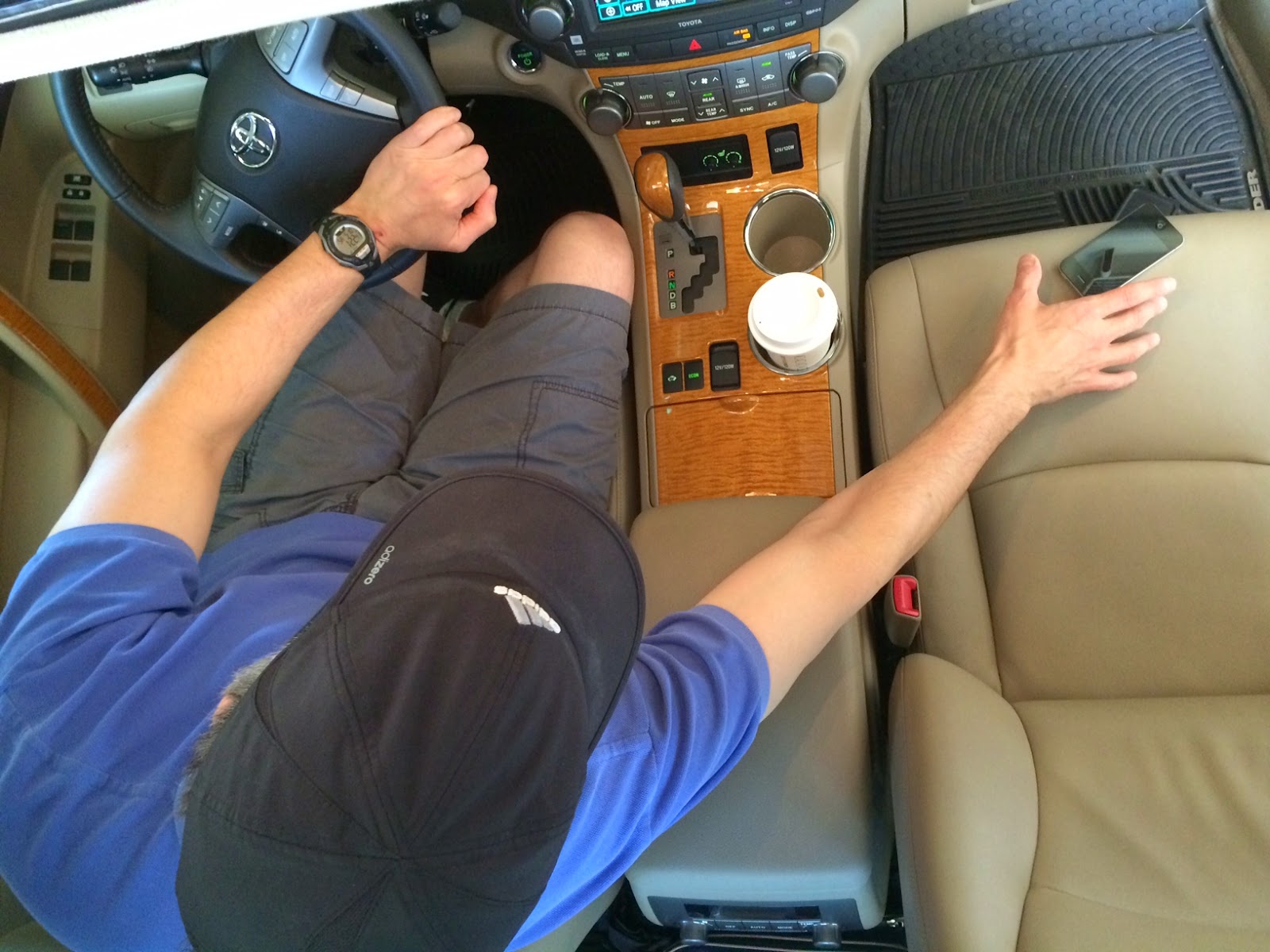
"I Was Just Reaching to Pick Up My Phone!"


Why do so many negligent drivers give the excuse that they "were just reaching over to pick up their cell phone" after they have caused a tragic accident?  Do negligent drivers feel this is a more acceptable or less blame-worthy response to give the Police than I was sending a text message or trying to make a call?  Is this the way a guilty conscience forms the words so as to allow the person to feel they are at least taking partial responsibility for their bad behavior?  This week 21 year-old Chelsey Northrup was tragically killed when a negligent driver crossed the center-line while allegedly "reaching for his phone" on Parker Road near the intersection with Scio Church Road in Washtenaw County.  Additionally, this week a negligent driver allegedly "reaching for his phone" crossed the center-line on the dangerous M-14 and Barton Road exit in Ann Arbor and broadsided a car driven by a woman who was 33 weeks pregnant causing her to go into contractions.  These unnecessary tragedies should remind us all to put away our phones and seriously re-affirm the promises we make to ourselves and others to END distracted driving.    

Sunday, May 4, 2014

Dramatic Increase in Women Being Arrested for Drunk Driving


Federal Bureau of Investigation (F.B.I.) statistics show a twenty-one percent (21%) increase in Driving Under the Influence (DUI) arrests among women during the nine year period between 2003 and 2012.  Annual arrests among women increased from 174,000 to 650,000 nationwide.  Interestingly, annual arrest among men decreased by nearly 17 percent during this same time period (780,000 down to 650,000 nationwide).  Social science experts speculate that the increase in arrests of women may be due to more women being in the workforce so more miles are being driven by women and more driving occurs at night when they are more likely to be arrested for drunken driving.  Additionally, experts believe that it has become more socially acceptable than it used to be for women to drink in public, especially among young women.  Finally, many states have eliminated first offender diversion programs, so more women are being pushed into the criminal justice system without an ability to by-pass it.

The Michigan Office of Highway Safety Planning reports that in Michigan the number of drunk driving crashes have decreased for both men and women.  From 2003 to 2012 the number of drunk driving crashes for men decreased from 11,400 to 7,250.  During this same time period, drunk driving crashes for women decreased from 3,203 to 2,563 for women.  In 2012, 35 drunk driving crashes in Michigan were fatal for women and of these 68% involved young women between the ages of 21 to 34.  Substance abuse scientists report that women metabolize alcohol differently than men do and they do it in such a way that they're going to get more intoxicated at a faster rate.  If a 150 pound man and a 150 pound women have the same amount of alcohol, the women will be at a higher blood-alcohol content quicker.  With the legal driving limit for blood alcohol content dropping from 2003 to 2011 in many states, police are arresting more women for DUI's and as explained above there are many causative factors.  Perhaps more public service t.v., radio, and social media advertisements need to target young women warning them of their increased risks and encouraging them to use designated drivers.